
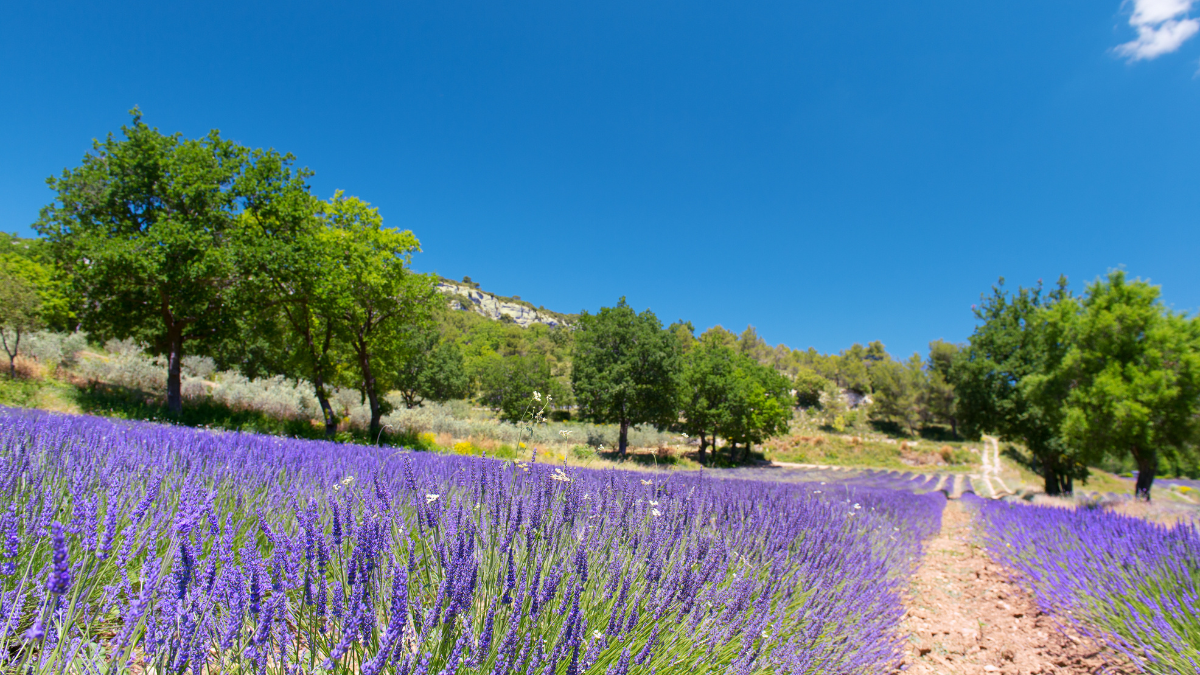
Everything you always wanted to know about Luberon lavender
Lavender is much more than just a plant. It is a symbol of Provence, known throughout the world. It fascinates tourists and is a source of pride for the inhabitants of the south of France. While blue gold is an integral part of Provençal heritage, there is one area where its cultivation is deeply rooted in tradition: the Luberon. Straddling the Alpes-de-Haute-Provence and Vaucluse departments, this area, recognised as a World Biosphere Reserve, is ideal for enjoying the landscapes enhanced by lavender. That’s why, in this article, we’re going to trace the history of this iconic plant and tell you where to go to find out more. We’ll finish with the best ways to explore the lavender fields of the Luberon. Follow the guide!
The history of Luberon lavender
Contrary to popular belief, lavender is not a native plant. Its arrival in Provence was the result of a mixing of Latin populations in ancient times. It first grew wild in the Provençal Alps, much to the delight of the Romans, who used it to wash their clothes and protect them from moths.
The origins of lavender cultivation
In the Middle Ages, the antiseptic properties of this plant were recognised. Monks and herbalists began to cultivate it to make remedies. However, it was not until the 19th century that lavender became an integral part of Provençal agriculture. This change was due to the town of Grasse, where the perfume industry was developing rapidly. Demand for lavender essential oil grew steadily. And so, fields of blue gold began to spring up in the Luberon and neighbouring areas.
Lavender cultivation today
À l’heure actuelle, la culture de la lavande reste un atout majeur pour l’économie provençale. D’ailleurs, le sud-est de la France en est un des plus gros producteurs mondiaux. L’huile essentielle issue des champs de lavande du Luberon est utilisée dans la confection de parfums, les cosmétiques et l’aromathérapie.
Peut-être avez-vous déjà entendu parler de lavandin ? Il s’agit d’une plante hybride de la lavande originelle. Leur différence tient dans leur nombre de brins. Le lavandin en possède trois quand la lavande n’en présente qu’un. Pour savoir si vous êtes en train d’observer un champ de lavande ou de lavandin, vous pouvez vous fier à la forme de leurs pieds. Ceux du lavandin sont plus réguliers. La lavande vraie, quant à elle, garde un aspect plus sauvage. Enfin, même si cette caractéristique a tendance à s’effacer avec le réchauffement climatique, il faut savoir que la lavande ne pousse qu’au-dessus de 600 mètres d’altitude.
Sites dedicated to lavender in the Luberon
As lavender is the star of the Luberon, it makes sense that there are places dedicated to celebrating it. From exhibitions to crafts and festivals, here is a selection of places where you can find out more about this iconic plant.
The Lavender Museum in Coustellet
Ten minutes from Gordes, in the Vaucluse region, the Lavender Museum is located in a traditional Provençal farmhouse, surrounded by lavender fields, of course, as well as olive trees and umbrella pines. The museum is open to visitors, but it also offers workshops and a shop that is sure to delight you. Don’t hesitate to immerse yourself in the historical, cultural and olfactory heritage of the Luberon.
Distilleries in the Vaucluse
Si le raisin a ses caves, la lavande a ses distilleries. Durant les mois d’été, elles tournent à plein régime, en raison de la récolte. Les distilleries du Luberon perpétuent les traditions ancestrales pour produire une huile essentielle de lavande de haute qualité. C’est avec plaisir que les exploitants vous feront découvrir leurs infrastructures et le processus de distillation. Parmi les établissements à visiter, nous vous suggérons :
- the Agnels distillery in Apt, just a short walk from our Le Luberon campsite;
- the Les Coulets distillery, also in Apt;
- the Beaudon distillery in Bonnieux;
- and the Aroma’Plantes distillery in Sault.
📌 To find out everything you need to know about lavender and the exceptional heritage of the Pays d’Apt, visit the Tourist Office website!
Festivals celebrating lavender in the Luberon
Provence is famous for its Christmas traditions. But there are many other ways to celebrate throughout the year. The blue gold harvest is a great opportunity to do so. Here are two unmissable festivals celebrating Provence’s lavender:
- the lavender festival in Apt, in mid-July, where you can enjoy crafts, tastings and entertainment centred around this iconic plant;
- The Lavender Festival in Sault, in mid-August, which celebrates true lavender with a farmers’ market, a book fair and the French Lavender Harvesting Championship.
A holiday in the Luberon to discover blue gold
How about spending your next holiday in Provence, admiring our lavender fields? All you need to do is choose the right date and the ideal place to stay. That’s what we’ll be discussing in the last part of this article.
When is the best time to visit the Luberon to admire the lavender fields?
The lavender flowering season generally runs from mid-June to mid-July. As for harvesting, this takes place from mid-July (for lavandin) to mid-August for lavender grown at altitude. So, to make the most of our uniquely blue fields, we recommend taking your holiday in the Luberon from mid-June to mid-August.
Where can you find lavender in the Vaucluse?
We would be tempted to tell you that the lavender fields of the Luberon are everywhere. However, some places are really worth seeing. Here are our favourite spots to admire the lavender fields of the Vaucluse:
- the village of Aurel, whose panorama photographers and painters love to immortalise;
- Lioux, where lavender fields meet limestone cliffs;
- Saignon, the village perched high above with breathtaking views of the fields below;
- the Claparèdes plateau, where the bories (the famous Provençal stone huts) seem to watch over the lavender fields;
- the viewpoint on the Sault plateau, which offers a panoramic view of the entire lavender country;
- The Cistercian Abbey of Sénanque, in Gordes, where culture and historical heritage form a unique blend.
📌 Provence’s blue gold is not the only heritage treasure in the Luberon. Discover our suggestions for excursions to make the most of your stay.
How to explore the lavender fields in Provence?
There are many ways to enjoy the beauty of the lavender fields during your holiday in the Vaucluse. We recommend the following:
- Discover Provence’s blue gold on a two-stroke moped. Ideal for lovers of unusual activities.
- Cycling is also a great option. It allows you to enjoy some exercise while relaxing and letting the sun tan your skin.
- Hiking is the most popular activity in the Luberon. For a route that showcases lavender, we invite you to take the trails of the Claparèdes plateau.
We would nevertheless like to remind you that lavender fields are fragile ecosystems. Lavender growers work with passion; it is essential to preserve their crops. Therefore, please do not enter their properties..
Where to stay to enjoy the blue gold during your holidays?
You’re probably wondering where to stay in the Luberon during your discovery trip. Obviously, a campsite surrounded by nature would be ideal. Luckily, ours is located in the heart of the Apt region, the capital of lavender. Another bonus is that our campsite is environmentally friendly. And since camping in the Luberon is always a good idea, we can only recommend that you book your stay with us.
Now you know as much as we do about Luberon lavender. But what you may not know is that we offer short breaks during the flowering season. So book your next holiday in the heart of the Luberon now!